
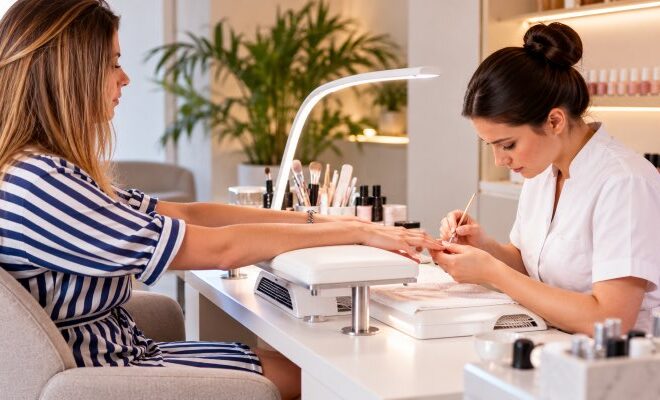
The transformation of the aesthetic nail care industry from a craft-based practice into a high-tech service business requires a fundamental reassessment of approaches to managing operational efficiency. This article examines workplace ergonomics not merely as an element of corporate employee well-being, but as a critical economic driver of profitability, a tool for managing occupational risks, and a factor in increasing customer Lifetime Value (LTV). Based on verifiable occupational health data, the article demonstrates a direct correlation between biomechanical optimization of work processes and the financial sustainability of a business.
Traditional management in the beauty industry has historically focused on marketing, customer service, and consumable supply costs, while systematically overlooking biomechanical and operational costs. In the post-pandemic environment, the unit economics of a beauty salon depend critically on the practitioner’s utilization rate. According to data from the U.S. National Institute for Occupational Safety and Health, nail technicians are considered an occupational group at risk of developing musculoskeletal disorders (MSDs) due to the repetitive movements and prolonged static postures required by their work.
A clinical study published in Occupational Medicine (Harris-Roberts et al., 2011) provides evidence of a significant relationship between workplace biomechanics and employee health: nail technicians show a statistically significant increase in the prevalence of work-related health conditions, including pain in the neck, shoulders, wrists, and lower back.
For businesses, this clinical finding has direct operational and financial implications. Chronic pain reduces effective workstation utilization due to the need for unplanned breaks and, over time, contributes to substantial employee turnover, which may reach 30–40% annually in the premium segment. The financial cost of replacing a qualified specialist—including recruitment expenses, the ramp-up period for a new technician, and the irreversible loss of the departing employee’s client base—can be equivalent to 1.5–2 months of the departing employee’s revenue. These hidden costs directly erode operating profit and reduce the salon’s EBITDA. Therefore, implementing ergonomic standards is no longer merely a matter of corporate ethics; it becomes a tool for P&L management and for protecting the financial sustainability of the business.
Analytical Case Studies: Process Design Errors and Their Economic Cost
Case Study 1. The Timing Acceleration Trap and Biomechanical Compromise
Scenario: A salon chain made a management decision to increase margins by reducing the standard service time for a “machine manicure with gel polish” from 120 to 90 minutes, without adapting the workstation ergonomics. Technicians were given a strict service-speed KPI.
Error: Management failed to account for the fact that reducing service time without optimizing workplace biomechanics forces technicians to work at extreme drill-bit angles and with excessive static tension in the hand in order to maintain control.
Economic Consequences: Physical fatigue resulted in a loss of fine motor precision toward the end of the workday. An increase in cuticle micro-injuries and nail plate damage was documented. Under these conditions, rework and customer compensation costs increase substantially. The cost of warranty rework—including materials and paid technician time—directly erodes the margin gained through “speeding up” the service. In addition, the increase in work-related pain led to more sick leave, lower workstation utilization, and higher employee turnover.
Solution: Implement height-adjustable ergonomic workstations to accommodate each technician’s stature, allowing them to maintain a neutral body position and an optimal working distance. In addition, transition to drills with ergonomically designed, thicker handles to reduce compressive loads on the finger joints, and optimize reach zones according to the “golden triangle” principle.
Result: A return to a biomechanically justified service time of 110 minutes. By eliminating fatigue-related pauses and reducing the rework rate, actual daily revenue increased, while expenses associated with defect compensation and recruitment fell to the industry minimum.
Case Study 2. Hidden Costs of Microclimate and Dust Extraction
Scenario: During the design of a luxury salon space, the budget allocation for an under-table dust extraction system and specialized task lighting was reduced.
Error: Management failed to account for dust generation. Fine abrasive dust (PM2.5 and PM10) generated during filing settles on the nail plate and enters the respiratory tract. Inadequate lighting forced technicians to lean forward more, compromising posture and bringing their eyes closer to the source of dust generation.
Economic Consequences: The presence of dust particles on the nail plate prior to base application significantly reduces material adhesion. This resulted in widespread coating lifting within the first few days after the service, negatively affecting the “Right First Time” quality metric. The cost of discarded materials and unpaid rework became one of the major sources of nonproductive expenditure, classified as a cost of poor quality. In addition, respiratory complaints among technicians contributed to accelerated burnout.
Solution: Invest in worktables with integrated, low-noise dust extraction systems and shadow-free LED task lighting with a high Color Rendering Index (CRI > 95).
Result: The rate of coating lifting fell to statistically negligible levels. The investment in microclimate ergonomics paid for itself solely through savings on material waste and the costs associated with correcting defects. In addition, the improvements supported employee health and contributed to a higher Net Promoter Score (NPS).
ROI of Ergonomic Standards Implementation: Macroeconomic Impact
The economic model for implementing ergonomics in aesthetic service businesses is based on three verifiable pillars:
- Reduction of Operating Costs and ROI of Interventions. According to data from the University of California, Berkeley Center for Occupational and Environmental Health, the benefit-to-cost ratio of ergonomic interventions ranges from 2:1 to 10:1. This means that every dollar invested can generate benefits equivalent to $2 to $10 through reduced workers’ compensation costs, fewer sick days, and increased labor productivity. Ergonomically balanced tools can also reduce vibration exposure, extending the service interval of high-cost micromotor systems used for nail services.
- Human Capital Management and Employee Retention. Reducing the incidence of MSDs is directly associated with lower employee turnover. Retaining an experienced nail technician eliminates the cost of training a replacement and helps prevent the loss of the technician’s personal client base, which is a critical factor in maintaining stable salon revenue.
- Increasing Customer LTV Through Service Quality. Technician comfort directly affects the precision and consistency of their movements, as well as their ability to maintain attentive and empathetic customer interactions. As a result, customers receive consistently high-quality results. In the service economy, where NPS is a major driver of organic growth, reducing defects caused by technician fatigue directly increases customer LTV.
Conclusion
In modern aesthetic nail care, ergonomics has ceased to be merely a matter of corporate ethics and has become a fundamental economic imperative. Management teams that integrate ergonomic standards into their operational processes mitigate the risks of occupational illness, optimize material consumption, and establish a sustainable competitive advantage. For industry professionals and investors, recognizing ergonomics as a tool for financial engineering is a marker of business maturity. Implementing scientifically grounded occupational health and ergonomic standards is not an expense; it is a strategic investment in operational efficiency and the long-term profitability of a service business.
Author
OLGA DZITSOEVA is a Founder & CEO in Beauty Industry / Specialist in Ergonomic Salon Operations & High Client Retention Methodology
References
- Center for Occupational and Environmental Health. “The Economics of Ergonomics.” UC Berkeley.
- Harris-Roberts, J., J. Bowen, J. Sumner, M. Stocks-Greaves, L. Bradshaw, D. Fishwick, and C. M. Barber. “Work-related symptoms in nail salon technicians.” Occupational Medicine 61, no. 5 (2011): 335–340.
- National Institute for Occupational Safety and Health. “Nail Salon Workers.” Centers for Disease Control and Prevention.
- Occupational Safety and Health Administration. “Awkward Positions and Motions.” U.S. Department of Labor.
- Roelofs, C., D. H. Wegman, S. R. Durgan, et al. “Results from a community-based occupational health survey of nail salon technicians.” American Journal of Industrial Medicine 51, no. 11 (2008): 843–852.


